What is the difference between NTFS and fat32?
 Noah Mitchell
 .
Consequently, which is better ntfs or fat32?
NTFS has great security, file by file compression, quotas and file encryption. If there is more than one operating system on a single computer, it is better to format some volumes as FAT32. If there is only Windows OS, NTFS is perfectly fine. Thus in a Windows computer system NTFS is a better option.
Additionally, should bootable USB be NTFS or fat32? A: Most USB boot sticks are formatted as NTFS, which includes those created by the Microsoft Store Windows USB/DVD download tool. UEFI systems (such as Windows 8) can't boot from an NTFS device, only FAT32. You can now boot your UEFI system and install Windows from this FAT32 USB drive.
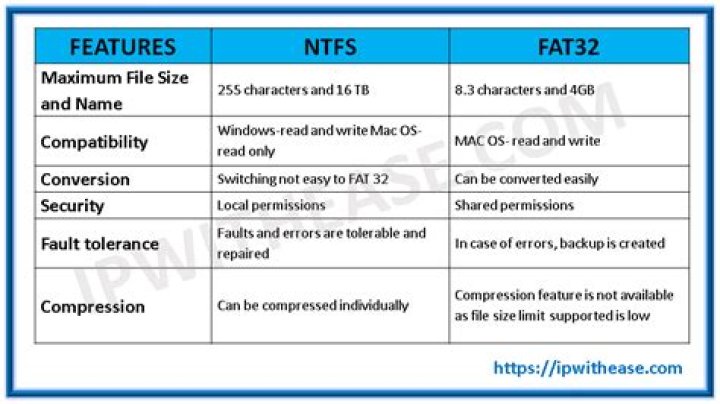
Herein, what is the difference between NTFS and FAT 32?
The FAT32 is simple while the NTFS structure is quite complicated. NTFS can support larger file and volume sizes along with large file names relative to the FAT32 file system. FAT32 does not provide encryption and much security whereas NTFS is enabled with security and encryption.
What file system should I use for my USB drive?
- If you want to share your files with the most devices and none of the files are larger than 4 GB, choose FAT32.
- If you have files larger than 4 GB, but still want pretty good support across devices, choose exFAT.
- If you have files larger than 4 GB and mostly share with Windows PCs, choose NTFS.
Related Question Answers
Does NTFS support journaling?
Since NTFS is a journaling file system, it can auto-repair the internal data structures that are used to keep track of files, so the drive itself remains logically consistent. The file is correctly set to the final size, and its directory entry is properly linked in.What is NTFS used for?
NTFS (NT file system; sometimes New Technology File System) is the file system that the Windows NT operating system uses for storing and retrieving files on a hard disk. NTFS is the Windows NT equivalent of the Windows 95 file allocation table (FAT) and the OS/2 High Performance File System (HPFS).What is best format for SD card?
As you can see from the table above, FAT32 is the recommended file system for SD and SDHC cards. However FAT32 does have some limitations including a maximum file size of 4GB.Can I format a 128gb flash drive to fat32?
Format 128GB USB into FAT32 within three stepsIn the main user interface, right click the partition on 128GB USB flash drive or SD card and select Format Partition. Step 2. Set the file system of partition to FAT32 and then click OK button. You are allowed to change cluster size or add partition label as well.What does fat32 mean on SD card?
In recent years, memory cards have gained more storage capacity; 4GB and above. The file format FAT32 is now commonly used in memory cards between 4GB and 32GB. If a digital device supports only the FAT16 file system you cannot use a memory card bigger than 2GB (i.e. SDHC/microSDHC or SDXC/microSDXC memory cards).How do I format a 1tb hard drive to fat32?
You got two ways to format hard drive to Fat32. Open Disk Management, right-click the drive you want to format and select “Format”. Yet the “FAT32” in the drop down menu will be invalid if the size of the pitched-on drive is larger than 32GB. Then you can try CMD format (cannot be done in Windows XP).What are the advantages of NTFS over fat32?
Advantages and DisadvantagesNTFS has great security, file by file compression, quotas and file encryption. If there is more than one operating system on a single computer, it is better to format some volumes as FAT32.What is the best format for USB?
The two most common formats are probably NTFS and FAT32. Althought NTFS is normally the most common, if you're going to be storing documents or music under 4 gb's (this is the file size limit for this format), FAT32 is your best bet due to it's superior speed capabilities.Should I use exFAT or NTFS?
More devices support exFAT than support NTFS, but some—particularly older ones—may only support FAT32. NTFS is ideal for internal drives, while exFAT is generally ideal for flash drives. However, you may sometimes need to format an external drive with FAT32 if exFAT isn't supported on a device you need to use it with.Will exFAT work for fat32?
FAT32 is an older file system used for USB flash drives and other external drives due to its great compatibility. exFAT is a replacement for FAT32, which is not as compatible as FAT32 but without the limitations of FAT32.Is fat32 or NTFS better for flash drives?
FAT and FAT32 are suitable for usb drives smaller than 32 GB or / and if you do not need to store files larger than 2 and 4 GB. Due to the peculiarities of the file system, NTFS is not recommended for flash drives, even if their capacity is > 32GB. The compromise solution will be the exFAT file system.Is fat32 the same as NTFS?
FAT32 is an older file system that's largely relegated to USB flash drives and other external drives. Windows uses NTFS for its system drive, and it's also ideal for other internal drives. exFAT is a modern replacement for FAT32, and more devices support it than do NTFS — although it's not as widespread as FAT32.Can I use exFAT for Tesla?
This is an issue because the Tesla Dashcam needs flash drives to be formatted to FAT32, and the native Windows drive formatting tool won't format flash drives and SD cards to FAT32, but exFAT.Should I use exFAT for external hard drive?
The Best Format for External Hard DrivesIf you want to format your external hard drive to work with Mac and Windows computers, you should use exFAT. With exFAT, you can store files of any size, and use it with any computer made in the last 20 years.How do I format a large USB to fat32?
In the “FAT32 Format” window, select the drive to format and type a volume label if you want to. Select the “Quick Format” option, and then click the “Start” button. A window pops up to warn you that all data on the drive will be lost. Click “OK” to format the drive.How do I boot from USB fat32?
It's the easiest option if you want to boot windows 10 in only UEFI mode.- First mount the Windows 10 ISO file by right clicking over it.
- Plug in a USB drive to your PC, capacity of 8 GB or more.
- Format the USB drive to FAT32 filesystem.
- Copy all the contents from the mounted ISO file to the USB drive.