What is blood clotting factor?
 Andrew Adams
 .
Likewise, people ask, what are the 13 blood clotting factors?
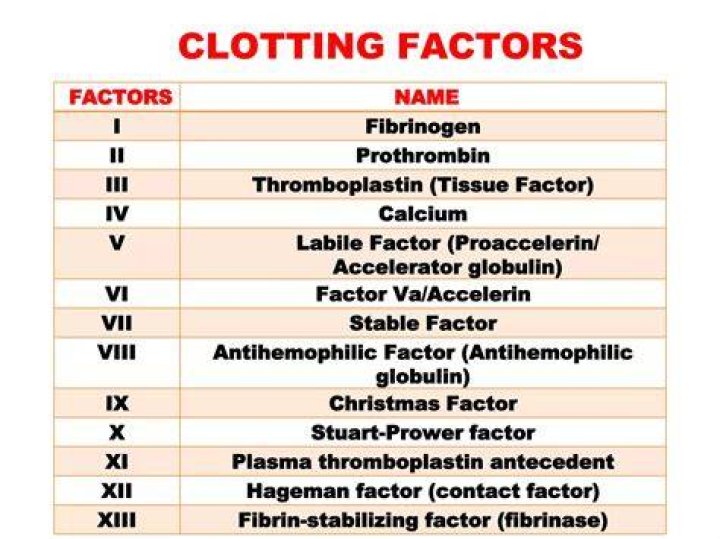
The following are coagulation factors and their common names:
- Factor I - fibrinogen.
- Factor II - prothrombin.
- Factor III - tissue thromboplastin (tissue factor)
- Factor IV - ionized calcium ( Ca++ )
- Factor V - labile factor or proaccelerin.
- Factor VI - unassigned.
- Factor VII - stable factor or proconvertin.
Beside above, what is the role of clotting factors? Clotting factors are proteins found in blood that work together to make a blood clot. Tiny cells in the blood called platelets stick together around the wound to patch the leak. Blood proteins and platelets come together and form what is known as a fibrin clot. The clot acts like a mesh to stop the bleeding.
Simply so, what is the blood test for clotting factor?
Coagulation factors are usually tested by measuring the factor's activity level in the blood. Activity assays can detect reduced levels of protein or proteins that don't function properly. Rarely, the amount (antigen level) of a coagulation factor may also be measured.
Where are blood clotting factors produced?
liver
Related Question Answers
What is normal clotting time?
Normal value of clotting time is 8 to 15 minutes. For the measurement of clotting time by test tube method, blood is placed in a glass test tube and kept at 37° C. The required time is measured for the blood to clot.What clotting factor is calcium?
Clotting factor IV is a calcium ion that plays an important role in all 3 pathways. Some of the clotting factors function as serine proteases, specifically factors II, VI, IX, and X.How do blood clots form?
How Does Blood Clot?- Platelets form a plug. Tiny bits in your blood called platelets get "turned on" by triggers released when a blood vessel is damaged.
- The clot grows. Proteins in your blood called clotting factors signal each other to cause a rapid chain reaction.
What are the 12 blood clotting factors?
Respectively, each one is named, fibrinogen, prothrombin, Christmas factor, Stuart-Prower factor, plasma thromboplastin, and Hageman factor. The extrinsic pathway consists of factors I, II, VII, and X. Factor VII is called stable factor.Where is tissue factor found?
Tissue factor (TF) is an integral membrane protein that is the essential cofactor component of the TF-factor VIIa complex enzyme. TF is expressed in the vascular adventitia, in astroglial cells, in organ capsules and is found in the central nervous system, lungs, and placenta at relatively high concentrations.What affects blood coagulation?
Hemophilia A and B are conditions that occur when there are low levels of clotting factors in your blood. Factor II, V, VII, X, or XII deficiencies are bleeding disorders related to blood clotting problems or abnormal bleeding problems. Von Willebrand's disease is the most common inherited bleeding disorder.What test is used to check for blood clots?
A. Most often, ultrasound is used to diagnose blood clots in the leg veins. This is a non-invasive test. If the results are not definitive, then venography (an invasive test using contrast dye) or MRI (magnetic resonance imaging) may be used.What is a dangerous INR level?
If an INR score is too low, a patient can be at risk for a blood clot. However, if the INR is too high, patients could also experience bleeding. A typical INR score ranges between 2 to 3. The “ideal” INR score can vary from patient to patient.What are the 3 stages of blood clotting?
Hemostasis includes three steps that occur in a rapid sequence: (1) vascular spasm, or vasoconstriction, a brief and intense contraction of blood vessels; (2) formation of a platelet plug; and (3) blood clotting or coagulation, which reinforces the platelet plug with fibrin mesh that acts as a glue to hold the clotWhat are the most common blood clotting disorders?
Inherited hypercoagulable conditions include:- Factor V Leiden (the most common)
- Prothrombin gene mutation.
- Deficiencies of natural proteins that prevent clotting (such as antithrombin, protein C and protein S)
- Elevated levels of homocysteine.
- Elevated levels of fibrinogen or dysfunctional fibrinogen (dysfibrinogenemia)
What are the symptoms of a blood clotting disorder?
Symptoms of coagulation disorders with difficulty clotting include:- Blood in the urine or stool.
- Bruising easily and excessively.
- Extreme fatigue.
- An injury that will not stop bleeding.
- Joint pain caused by internal bleeding.
- Nosebleeds that seem to have no cause.
- A painful headache that will not go away.