What happens in translation quizlet?
 Lucas Hayes
.
Similarly, you may ask, what occurs during translation?
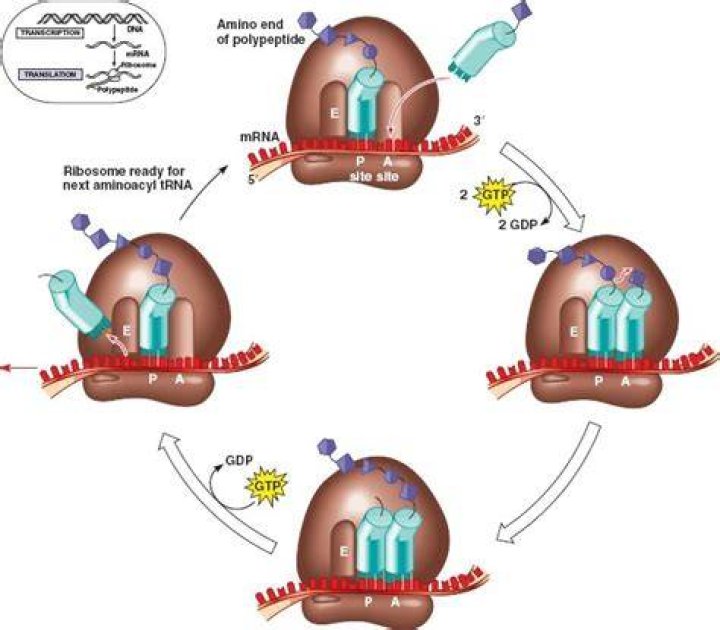
Translation is the process by which a protein is synthesized from the information contained in a molecule of messenger RNA (mRNA). Translation occurs in a structure called the ribosome, which is a factory for the synthesis of proteins.
what happens during the process of translation quizlet? The cell uses information from messenger RNA to produce proteins. During translation, the type of amino acid that is added to the growing polypeptide depends on the codon on the mRNA and the anticodon on the tRNA to which the amino acid is attached.
Consequently, what happens during each stage of translation?
Translation is a process by which the genetic code contained within an mRNA molecule is decoded to produce the specific sequence of amino acids in a polypeptide chain. It occurs in the cytoplasm following transcription and, like transcription, has three stages: initiation, elongation and termination.
What is translation quizlet?
An enzyme that synthesizes the formation of RNA from a DNA template during transcription. Translation. The process of translating the sequence of a messenger RNA (mRNA) molecule to a sequence of amino acids during protein synthesis. Codon.
Related Question Answers
What is the product of translation?
The molecule that results from translation is protein -- or more precisely, translation produces short sequences of amino acids called peptides that get stitched together and become proteins. During translation, little protein factories called ribosomes read the messenger RNA sequences.What is the purpose of translation?
Translation is the communication of meaning from one language (the source) to another language (the target). The purpose of translation is to convey the original tone and intent of a message, taking into account cultural and regional differences between source and target languages.What does tRNA do in translation?
transfer RNA (tRNA) – a type of RNA that is folded into a three-dimensional structure. tRNA carries and transfers an amino acid to the polypeptide chain being assembled during translation. translation – the process in which a cell converts genetic information carried in an mRNA molecule into a protein.Why do we need translation?
Translation is necessary for the spreading new information, knowledge, and ideas across the world. It is absolutely necessary to achieve effective communication between different cultures. In the process of spreading new information, translation is something that can change history.What occurs during transcription and translation?
The mRNA formed in transcription is transported out of the nucleus, into the cytoplasm, to the ribosome (the cell's protein synthesis factory). The process by which mRNA directs protein synthesis with the assistance of tRNA is called translation. The ribosome is a very large complex of RNA and protein molecules.Which occurs during translation elongation?
Translation: Elongation. Translation elongation is simply the ribosome travelling down the message, reading codons and bringing in the proper aminoacyl tRNA's to translate the message out to protein. The incoming aminoacyl tRNA is brought into the ribosome A site, where it is matched with the codon being presented.Which molecules are involved in translation?
The molecules involved in translation are mRNA, ribosomes, and tRNA. During translation, messenger RNA (mRNA) attaches to the ribosome.What are the steps in the process of translation?
Translation proceeds in three phases:- Initiation: The ribosome assembles around the target mRNA.
- Elongation: The tRNA transfers an amino acid to the tRNA corresponding to the next codon.
- Termination: When a peptidyl tRNA encounters a stop codon, then the ribosome folds the polypeptide into its final structure.