What are sesamoid bones? | ContextResponse.com
 Robert King
 .
Also know, what are the sesamoid bones in the body?
Sesamoid bones can be found on joints throughout the body, including:
- In the knee—the patella (within the quadriceps tendon).
- In the hand—two sesamoid bones are commonly found in the distal portions of the first metacarpal bone (within the tendons of adductor pollicis and flexor pollicis brevis).
Secondly, are sesamoid bones normal? Introduction. The term sesamoid is used for certain small nodular foci composed of bone, cartilage, or both that are shaped like a sesame seed1. Sesamoid bones are common in humans, and vary in number. As many as 42 sesamoid bones can be found within a single person2.
Hereof, what is the purpose of the sesamoid bones?
Sesamoid bones are small more or less rounded masses embedded in certain tendons and usually related to joint surfaces. Their functions probably are to modify pressure, to diminish friction, and occasionally to alter the direction of a muscle pull.
How does a sesamoid bone develop?
Sesamoid bones form within tendons in regions that wrap around bony prominences. They are common in humans but variable in number. Sesamoid development is mediated epigenetically by local mechanical forces associated with skeletal geometry, posture, and muscular activity.
Related Question Answers
What is a Sesamoidectomy?
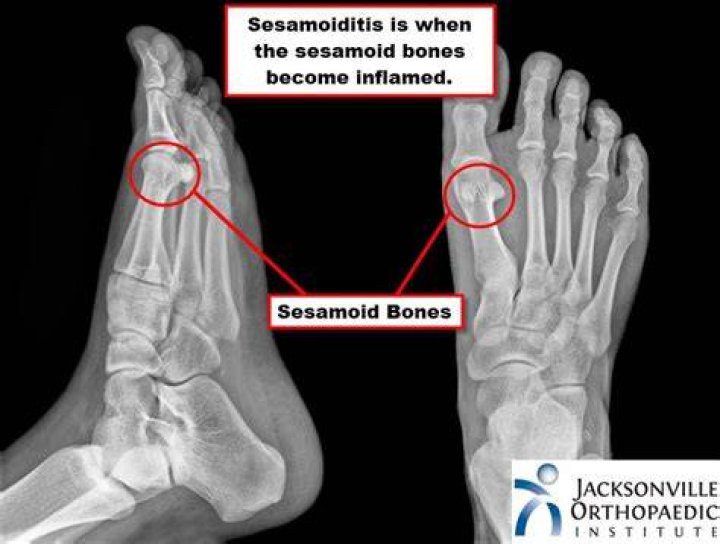
A sesamoidectomy is the removal of a sesamoid bone by surgical means. A sesamoid bone is a bone embedded within a tendon. In the foot, the first metatarsal bone usually has two sesamoid bones at its connection to the big toe.What are sesamoid bones used for?
The sesamoids also serve as a weightbearing surface for the first metatarsal bone (the long bone connected to the big toe), absorbing the weight placed on the ball of the foot when walking, running and jumping. Sesamoid injuries can involve the bones, tendons and/or surrounding tissue in the joint.What is an example of a sesamoid bone?
Sesamoid bones are bones embedded in tendons. These small, round bones are commonly found in the tendons of the hands, knees, and feet. Sesamoid bones function to protect tendons from stress and wear. The patella, commonly referred to as the kneecap, is an example of a sesamoid bone.How long does it take to recover from sesamoid surgery?
Your provider may give you a shot of steroid medicine. In some cases the painful sesamoid bone may need to be removed with surgery. Sesamoid injuries may be painful for weeks to months. Sesamoid fractures may take 4 to 8 weeks to heal.How many sesamoid bones are there in the human body?
The classic reference of the human body Grey's Anatomy stats 200 different bones, whereas Marieb et al., report a total number of 206 bones [1]. This difference is mainly caused by the variable existence of sesamoid bones. Sesamoid bones are bones, which are partially or completely embedded into tendons.How painful is Sesamoiditis?
The main symptom of sesamoiditis is pain that develops under the ball of the foot. The pain tends to build gradually, and you may notice some swelling or bruising. Sesamoiditis can make it difficult to straighten or bend your big toe. It may even hurt to move that toe.Where is a sesamoid bone most often found?
Where is a sesamoid bone most often found? near joints at the knee, the hands, and the feet.What is a floating bone?
Interestingly enough, hyoid means shaped like the greek upsilon. It's the one that gets broken when you are strangled or hanged. The hyoid is the only floating bone in the body. It is about 2 inches long, running parallel to the ground, and covers the voicebox, being held in place by three sets of muscles.Can you walk on a broken sesamoid?
It may be difficult to bend or straighten your big toe and to walk. You may or may not experience redness and swelling in the affected area. A sesamoid fracture causes immediate pain. You may develop a large bruise under your toe.Can sesamoid bones be removed?
Your surgeon may recommend removing part or all of the sesamoid bone. When bone is removed from only one sesamoid, the other sesamoid bone can still provide a fulcrum point for the toe flexors. The soft tissues enclosing the sesamoid are opened, and bone is removed. The tissues next to the sesamoid are stitched up.How do you prevent Sesamoiditis?
The best way to prevent sesamoiditis is to wear shoes with proper support. Custom orthotic inserts through Footmaxx may also decrease the risk of irritating the sesamoid bones if there are issues with the arch and foot posture.What is an example of a Sutural bone?
Examples of irregular bones are the vertebrae, hip bones, and several skull bones. Sutural bones are small, flat, irregularly shaped bones. They may be found between the flat bones of the skull. They vary in number, shape, size, and position.Is the elbow a sesamoid bone?
Sesamoid Bones. Sesamoid bones are located adjacent to the elbow, stifle, tarsus, and the metacarpophalangeal and metatarsophalangeal joints. If sesamoid bones are not identified on a radiograph, they may be absent or be cartilaginous at the time of radiography.Is a sesamoid bone a short bone?
Short bones are designated as those bones that are as wide as they are long. They are one of five types of bones: short, long, flat, irregular and sesamoid. Examples of these bones include the tarsals in the foot and the carpals in the hand.How do you fix Sesamoiditis?
Ways to treat sesamoiditis include:- stopping or reducing the activities causing pain.
- taking over-the-counter medications to relieve pain and inflammation.
- applying an ice pack for 10 minutes at a time to reduce inflammation.
- wearing comfortable, soft-soled, low heeled-shoes.
- inserting a cushioning insole inside the shoes.
How is Sesamoiditis treated?
Ways to treat sesamoiditis include: stopping or reducing the activities causing pain. taking over-the-counter medications to relieve pain and inflammation. applying an ice pack for 10 minutes at a time to reduce inflammation.Where is the sesamoid bone in a horse?
At the rear side of the pastern on each equine limb are two small sesamoid bones that provide anchor points for the two branches of the suspensory ligament. As elements of the pastern joint, the sesamoids are under stress each time the horse takes a step.How many sesamoid bones are in the hand?
five sesamoid bones